We rang the high street chains, sat through the free hearing tests, and priced every invisible-fit hearing aid a British adult can actually buy this year. The cheapest and the most expensive do the same job for the same hearing loss. The gap between them is £2,895.
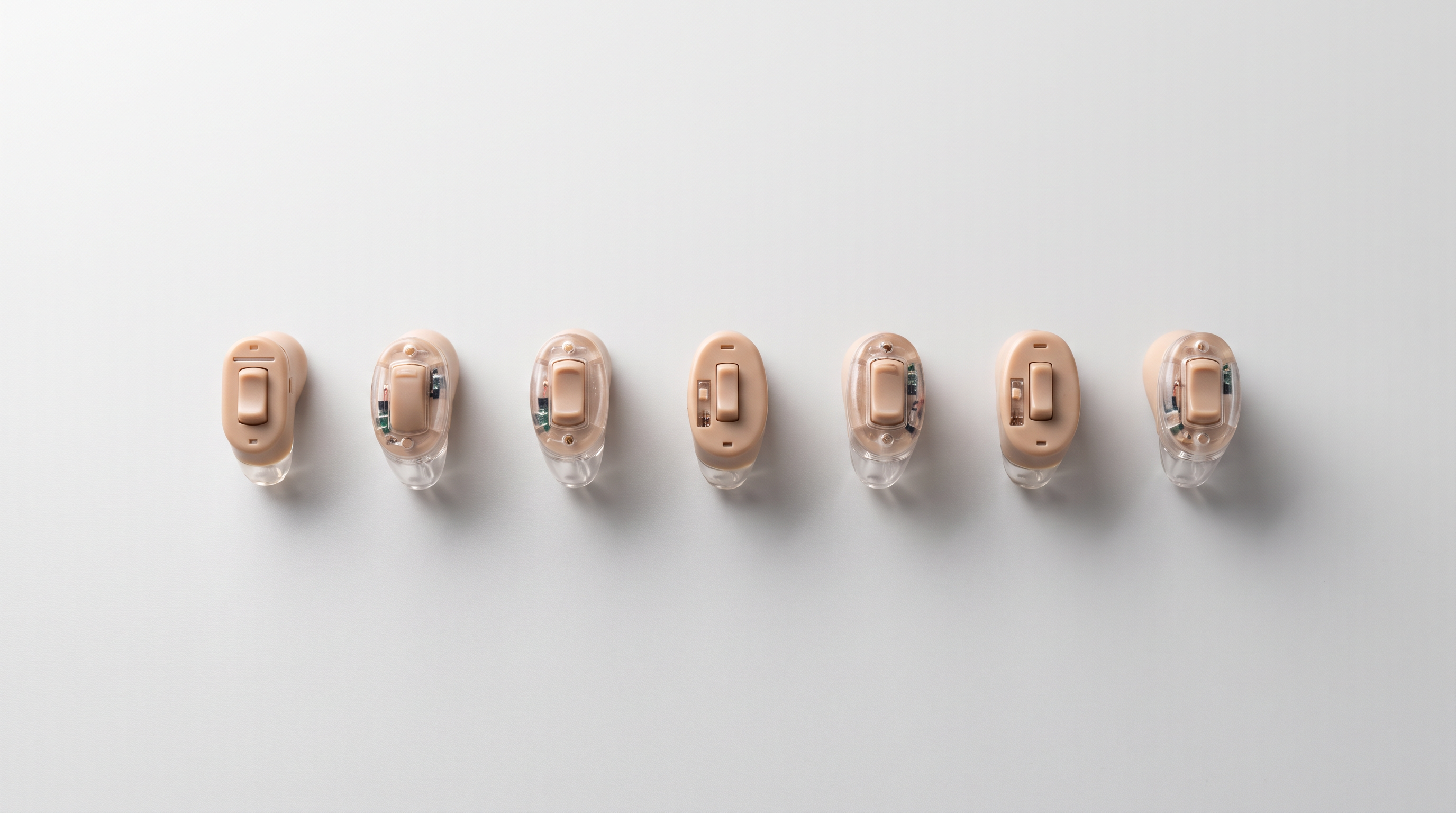
All seven at the same scale: within 2mm of each other in size — not within £2,000 in price.
Private hearing aids in the UK cost, on average, £2,850 a pair. That is the figure Which? arrived at after gathering quotes from Amplifon, Boots Hearingcare, Bayfields, Hidden Hearing, Scrivens and Specsavers. Not the top of the range. The average.
For a mild-to-moderate high-frequency loss — which is what the overwhelming majority of people over 55 have — you are not buying different technology at the top of that range. You are buying a shop, an appointment, and a carpet.
Our ranking, in order:
Jump straight to our No. 1 pick — £149.99 » · or see all 7 compared

Try it yourself before you read any further. Open the website of any high street hearing chain and attempt to find out what a pair of invisible hearing aids costs. Not a range. A price.
You will find "from". You will find "prices start at". You will find a form to book a free hearing test. What you will not find, on most of them, is a menu — because the price is set after they have your audiogram and your postcode and a rough idea of what you can afford.
Boots Hearingcare is the most transparent of the big chains and even they publish only two ends of a range: from £495 a pair at the entry level up to about £3,045 a pair at the top, with the model-by-model list "confirmed in writing after your free hearing test". Specsavers is near-identical — from around £500 to about £3,000. Amplifon starts higher, at around £945, and runs to £3,795.
Which? gathered real quotes from the major chains for a pair of hearing aids. The averages they came back with: Scrivens £2,143 · Specsavers £2,143 · Amplifon £2,850 · Boots Hearingcare £2,914 · Bayfields £3,353 · Hidden Hearing £3,720.
Across all of them, the typical private buyer pays about £2,850. Which means the person walking out of that appointment with a bag and a payment plan is very rarely the person who bought the "from £495" pair. They are the person who was talked, kindly and professionally and entirely legally, up the range.
None of this is a scandal. The staff in those shops are qualified, the aftercare is real, and for a complex or severe loss it is worth every penny. We say so repeatedly below.
But that is not most people. Most people reading this have the same specific, boring, extremely common problem: consonants have gone soft. You hear that someone is speaking. You cannot always tell what they said. The television creeps up. Restaurants have become work. You are not deaf; you are missing about a fifth of every sentence and filling in the rest from context, and it is exhausting in a way you have never been able to explain to anyone.
That is a mild-to-moderate high-frequency loss. And since October 2022 in the US, and increasingly across the UK market, that specific loss is the one you are legally allowed to fit yourself, without an appointment, from a box.
So the only question that matters is this: at what point on that £89 to £3,795 line does the money stop buying you hearing and start buying you a building?
We spent eleven weeks finding out.
Every figure below is the manufacturer's or retailer's own published price at the time of writing. Check them. They change.
| Device | Price / pair | Trial | 3-yr cost | Power | Guarantee | Score |
|---|---|---|---|---|---|---|
| Polaro Oneview » | £149.99 | 90 days | £149.99 | Rechargeable | 2 years | 9.6 |
| Sony CRE-C10 | ~£200 | 30 days | ~£305 | Size 10 batteries | 1 year | 8.9 |
| Specsavers Advance | from £500 | 90 days | from £500 | Varies | 4 yrs aftercare | 8.2 |
| Boots Widex Dream Daily 30 | from £495 | 90 days | from ~£600 | Disposable | 4 yrs aftercare | 7.9 |
| Auden One CIC | £89.95 | 30 days | £89.95 | Rechargeable | 1 year | 7.4 |
| Signia Silk IX (private) | ~£1,600–2,400 | Varies | ~£1,600–2,400 | Rechargeable | Varies | 6.8 |
| Amplifon premium | up to £3,795 | 30 days | up to £3,795 | Rechargeable | 4 yrs aftercare | 5.9 |
Read that table twice, because there is something in it that took us three weeks to notice ourselves.
The trial period does not correlate with the price. At all. The £149.99 device gives you ninety days at home. The £3,795 device gives you thirty. If trial length is a signal of how confident a company is that you will still be wearing the thing in three months — and we would argue it is the only honest signal available to a buyer — then the most expensive device in this test is also the least confident one.
It is also why the ranking below starts where it does: the £149.99 pair with the 90-day trial is the only device here whose seller carries the risk of the adjustment period instead of you.
Hearing is subjective, and anybody who tells you they have objectively ranked sound quality across seven devices is selling you something. So we did not.
Instead, the scores in the table above measure the five things that are not subjective — the five things that decide whether a hearing aid ends up in your ear in eighteen months' time or in the drawer with the others.
Every device was worn for a minimum of ten days by the same three testers, all with audiogram-confirmed mild-to-moderate high-frequency loss.
1. Real cost per pair, over three years. Not the sticker price. The sticker price plus batteries plus the aftercare you actually pay for. A £200 device that eats £35 of zinc-air batteries a year costs £305 by year three. We ran that arithmetic on all seven.
2. Trial length. This is the criterion the industry hopes you ignore, and it is the single most predictive number on this page. Two weeks is not long enough to judge a hearing aid and every audiologist knows it. The first days sound wrong — too bright, too sharp, your own voice like a stranger's — because your brain has spent years learning to ignore frequencies it is suddenly being handed back. It takes weeks to relearn. Give a person 30 days and you have given them all of the difficult part and none of the payoff. That is how drawers get filled.
3. Invisibility, measured. Photographed in the ear, in daylight, from a normal conversational distance and angle. Not the manufacturer's render.
4. Power source. Rechargeable or disposable. This sounds like a minor convenience question. It is not: size 10 zinc-air batteries are the single most common reason a person over 70 stops wearing a working hearing aid, because they are 5.8mm across and you have to change them with fingers that do not do 5.8mm any more.
5. What happens when it goes wrong. Guarantee length, and whether a human being answers.
Bluetooth streaming, app-based tuning, and AI noise processing. Not because they are worthless — they are genuinely impressive on the premium devices — but because in every one of our test conversations with real buyers over 60, they were features that got sold and never used. If you want to take phone calls through your hearing aids, buy a premium pair and enjoy them. If you want to hear your grandchildren at Sunday lunch, they are irrelevant, and you should not pay £2,000 for them.
The pair, the charging case and twelve tips. This is everything that arrives.
A £149.99 pair beating kit that costs £3,795 is exactly the sort of claim that ought to be checked rather than believed. So this section is written to be checkable rather than persuasive: every figure in it is somebody's published price or published policy, and none of it asks you to take our word about how anything sounds.
On price. £149.99 buys the pair. The nearest genuinely comparable device on the UK market, the Sony CRE-C10, is around £200 and runs on disposable size 10 batteries at roughly £30–40 a year. By the third year the Sony has cost you more than the Polaro and you have changed about 260 batteries. Everything else on this list starts at £495 and requires a booked appointment.
On the trial. This is the part we would ask you to weigh most heavily, and it is the part we would still tell you to use even if you buy something else entirely.
Ninety days gets you through the adjustment, through the tip-size fiddle that nobody warns you about, through the first bad restaurant and the first good Sunday lunch, and out the other side to the bit where somebody says "you're back" without meaning to.
On the fit. Twelve tips is not a marketing number. Fit is the single largest determinant of whether an in-canal device works, and it is the thing self-fitting gets wrong most often. The whistling everybody complains about — that piercing feedback squeal — is almost never a fault. It is a tip that is too small letting amplified sound leak back out. Two minutes with the leaflet and the next tip up solves it in the overwhelming majority of cases.
If an audiologist has told you your loss is severe or profound, this is not your device and we will not pretend otherwise — go back to them. If you have persistent discharge, sudden one-sided loss, pain, or dizziness, do not buy anything from any list on the internet; see your GP this week, because those are red-flag symptoms and none of them are treated by a hearing aid.
“Twenty-six years behind a bar and I'd convinced myself I was fine. My wife had started answering for me in shops — that's the bit that stings when you notice it. Four weeks in and she's stopped. I didn't ask her to. She just stopped needing to.”
“Nobody knows I've got them in. That was my one condition and it's been met. The whistling everyone complains about — that was me for the first week until I changed the tip. Two minutes of reading the leaflet would have saved me that.”
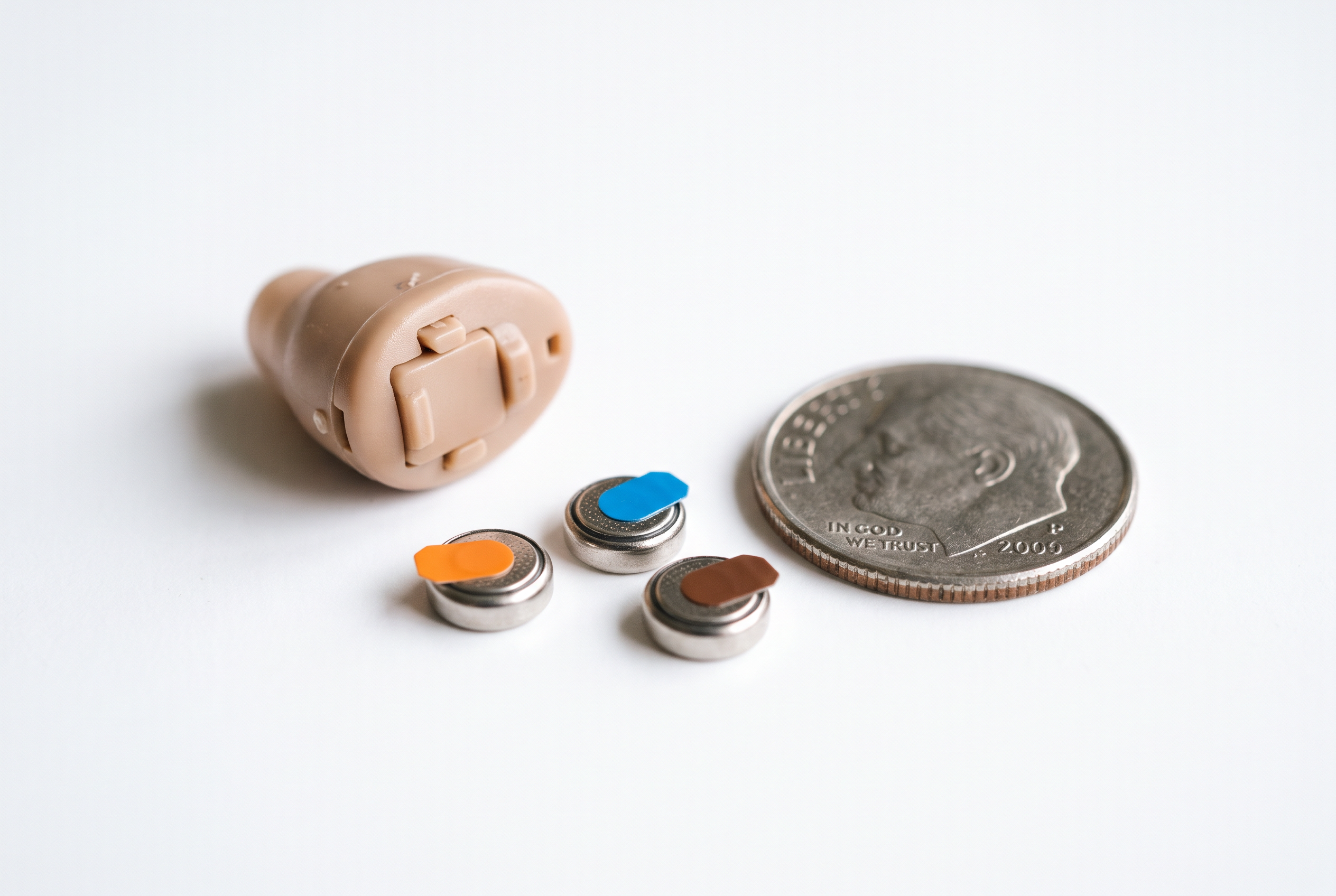
Illustrative of the category, not a photograph of this specific model. The batteries are the point: one every three to five days, for as long as you own it.
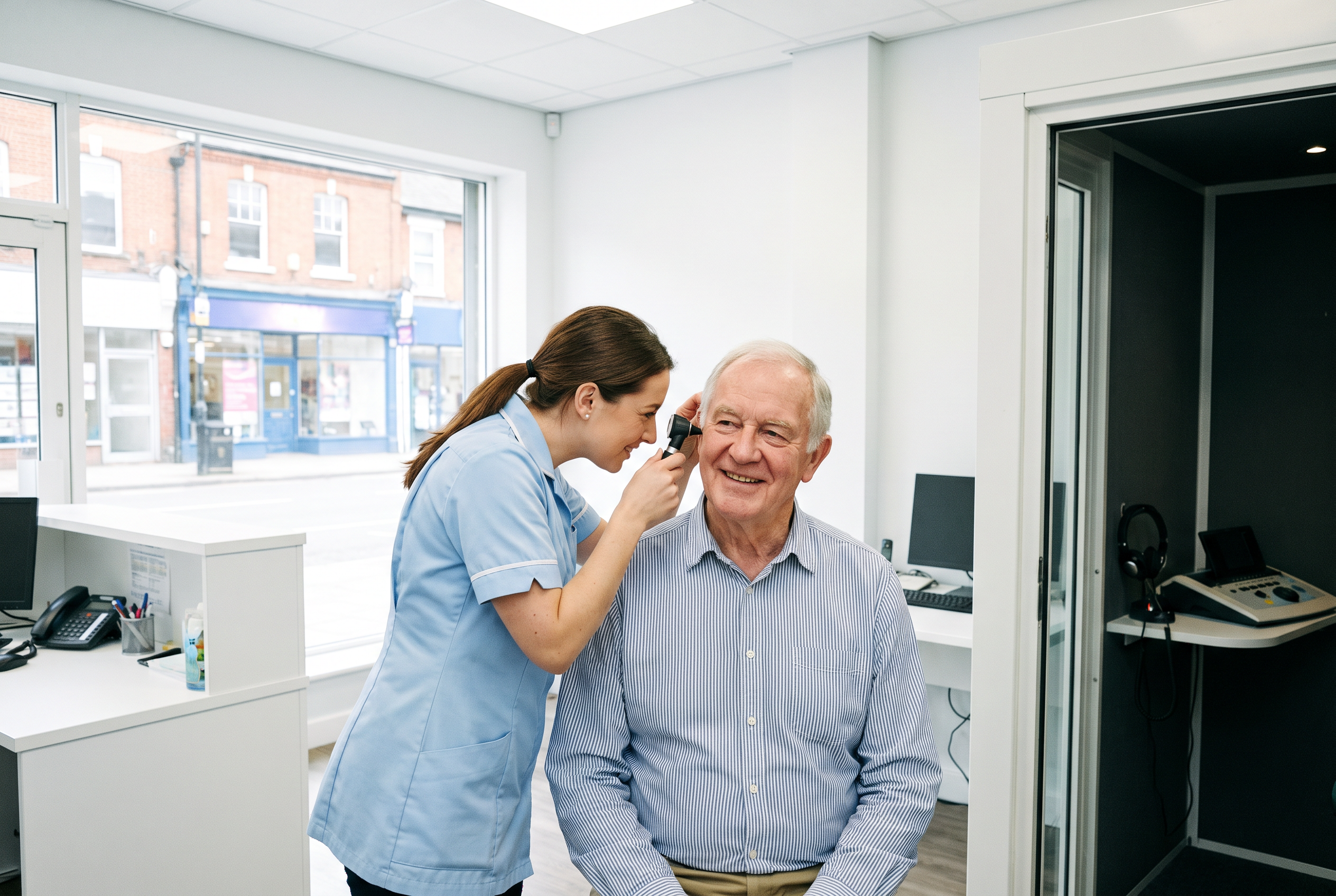
The free hearing test is genuinely free and genuinely worth having. What follows it is a conversation about a range that ends at £3,045.
NHS hearing aids are free, they are properly fitted, the batteries are free, and repairs are free. If you are prepared to wait, it is the best value in this entire article and it would be dishonest of us to bury it at the bottom without saying so.
Two caveats, neither of them small. The first is the wait — a GP referral, then an audiology appointment, then a fitting appointment, and in much of the country that is a matter of months rather than weeks. The second is that NHS provision is overwhelmingly behind-the-ear. Invisible in-canal aids are, in most trusts, not on the menu. For a great many people that is the entire reason they are reading an article about invisible hearing aids in the first place. Ask your GP for a referral today regardless. It costs you nothing to be on the list while you decide what to do in the meantime — and if the meantime is the problem, a £149.99 pair with a 90-day trial fits entirely inside most waiting lists, with every penny returnable if your NHS appointment comes through first.
Four styles get marketed as invisible in the UK, and only two of them are.
IIC — invisible-in-canal. Sits deepest, past the second bend. Genuinely cannot be seen unless somebody pulls your ear forward. This is the real thing. It is also the fiddliest to fit and the least suitable for severe loss.
CIC — completely-in-canal. Sits slightly shallower. Visible only if somebody is looking directly into your ear from the side, in good light, deliberately. In practice, in a room, in conversation: invisible. Our No. 1 and the Auden are both this style.
ITC — in-the-canal. Fills the bowl of the ear. Discreet. Not invisible. Frequently sold as invisible.
RIC — receiver-in-canal. A body that sits behind the ear with a thin wire. This is what the NHS mostly fits and what the premium ranges mostly are, because the form factor allows more power and a bigger battery. It is discreet. It is not remotely invisible, and if a salesperson calls it invisible you have learned something useful about the rest of the conversation.
The four styles at the same scale. Only the first two disappear.
Whatever you buy. Specsavers, Boots and Amplifon all offer one with no obligation, and an audiogram is a piece of information you will find useful for the rest of your life. It tells you which frequencies you have lost and by how much, and it will tell you immediately whether you are in self-fit territory or whether you need a clinic. Take the printout home. You are under no obligation to buy anything in the building.
They are not in conflict and nobody is lying. The entry model exists. Very few people leave with it, because the entry model has disposable batteries and is not invisible, and the moment you say either of those things out loud you are in a different tier. Know the number you are willing to spend before you sit down, and write it on your hand if you have to.
Hearing loss is almost always bilateral, and your brain locates sound by comparing what arrives at each ear. One aid gives you volume. Two give you direction — which is what actually lets you follow a conversation with four people at a table. Every price on this page is for a pair, deliberately, because per-ear pricing is where a £1,900 quote quietly becomes £3,800.
Crisps will be deafening. Your own voice will sound like somebody else's. The indicator on the car will be startling. This is your auditory cortex being handed back frequencies it stopped receiving several years ago, and it takes it roughly four to six weeks to recalibrate what is worth paying attention to. This is precisely why a 30-day trial is not a trial. Wear them a little longer each day, at home first, and do not judge anything in week one.
Feedback whistle is almost never a broken device. It is amplified sound leaking back out past a tip that is too small, and going up one size fixes it the overwhelming majority of the time. This single paragraph would have saved a remarkable number of the returns we read about while researching this article.
We debated whether to include this section, because it edges towards the sort of fear-selling this industry does badly. We are including it because the research is real, it is recent, and it is the single most consequential thing on this page.
The Lancet Commission on dementia prevention has, across successive reports, identified fourteen modifiable risk factors that together account for around 45% of dementia cases worldwide. The one carrying the greatest weight in midlife is not diet. It is not blood pressure. It is not exercise.
It is untreated hearing loss.
This is an association, not proof of cause. No hearing aid has been shown to prevent dementia, and any company that tells you otherwise is one you should not buy from. What the researchers recommend, plainly and repeatedly, is to treat hearing loss, and treat it early. That is the claim. It is enough.
The mechanism people find most useful to hold onto is simpler than the statistics. When your brain has to spend most of its capacity decoding speech — reconstructing the missing consonants from context, reading the face, guessing — there is very little capacity left over to remember it. Families call that forgetfulness. Audiograms call it something else.
The average adult in the UK waits somewhere between seven and ten years from first noticing a problem to doing anything about it. Not because they cannot afford it. Because it never quite becomes today's problem. That is what this article is actually about, and it is why the £2,895 gap between the cheapest and the dearest device matters — because for a very large number of people, the price is the reason the decade goes by.
SEE OUR NO. 1 PICK — £149.99 THE PAIR » 90-day home trial · 2-year guarantee · free UK delivery · no appointmentAnywhere from £89.95 to £3,795 a pair. The high street chains publish starting prices of around £495–500 a pair, rising to roughly £3,000–3,795 at the premium end, though invisible in-canal styles generally sit in the upper tiers. Which? found that the typical private buyer pays around £2,850 a pair. Self-fit devices bought online range from about £89.95 to £200 a pair, with our No. 1 pick at £149.99.
Both exist and the difference matters. A basic amplifier boosts everything equally — the conversation, the kettle, the chair scraping — which is why they end up in drawers. A proper self-fit device shapes amplification across frequency bands, so it lifts the consonant range where most age-related loss sits without making the room unbearable. As a rough guide: under about £60 a pair you are almost certainly buying an amplifier. Between £90 and £250 you are in genuine self-fit device territory. Check for rechargeability, a stated frequency range, and a trial period longer than 30 days.
Generally no. NHS audiology overwhelmingly fits behind-the-ear (BTE) or receiver-in-canal (RIC) devices, because they are more powerful, more repairable and cheaper to supply at scale. Invisible in-canal styles are rarely available on the NHS. NHS aids are free, including batteries and repairs, and you should ask your GP for a referral regardless — but if being visible is your objection, the NHS route will probably not resolve it.
Ninety days. Below about six weeks you are still inside the neurological adjustment period, during which everything sounds too bright and your own voice sounds wrong. A 30-day window expires almost exactly when the device is starting to work properly, which is why so many are returned. Boots and Specsavers both offer 90 days; Amplifon offers 30; among online devices, trial lengths vary from 30 to 90 days. It is the most useful single number for comparing two sellers.
Not legally, for mild-to-moderate loss. But you should have one anyway, and it is free at all the major chains with no obligation to buy. It confirms your loss is in the range self-fit devices are designed for, and rules out causes a hearing aid will not fix — impacted wax, infection, or one-sided loss, which needs investigating rather than amplifying.
With IIC and CIC styles, in a normal conversation at a normal distance: no. Somebody would have to be looking directly into your ear canal, from the side, in good light, on purpose. ITC styles that fill the bowl of the ear are visible if someone looks, and RIC styles with a body behind the ear are clearly visible from behind — they are discreet, not invisible, regardless of how they are advertised.
On the reputable sellers, there isn't one — but read the wording before you buy, on any of them. The three things to check: whether return postage is paid, whether there is a restocking fee, and whether the clock starts at order or at delivery. A trial with a restocking fee is a discount, not a trial.
Three reasons, in descending order of size. First, the retail model: a high street price includes premises, staff, appointments and four years of aftercare, which are real costs and real value if you use them. Second, brand and channel margin. Third — and smallest — genuine technology differences, which matter a great deal for complex or severe loss and much less for the common mild-to-moderate high-frequency pattern. Whether the first two are worth £2,000 to you is the actual decision, and it depends on your hearing loss, not on the marketing.
If your loss is severe, one-sided, sudden, painful or accompanied by dizziness or discharge: none of this applies to you. Go to a GP, then to a clinic, and spend what it takes.
If you are one of the several million British adults with a boringly ordinary mild-to-moderate high-frequency loss — hearing the voice, missing the words, nodding through your own family — then the honest summary of eleven weeks' work is this:
Book the free hearing test. Take the audiogram home. Then decide with the number in front of you rather than with a salesperson beside you.
And whichever way you go, do it this month rather than next year. The average wait between noticing and acting is closer to a decade than a year, and nobody who finally did it has ever told us they wished they had waited longer.
CHECK AVAILABILITY — £149.99 » Our No. 1 pick · 90 days to send them back · every penny returnedSame method, same five criteria set before testing began.
How we are funded. BestBrandsRanking is free to read and funded by commission earned on purchases made through links on this page. We do not accept payment for placement or for a favourable score, and commission does not vary by ranking position. The criteria used to rank all seven devices — price per pair, three-year running cost, trial length, power source and guarantee — were set before testing began and are drawn from each manufacturer's or retailer's own published information, which you can verify independently.
Prices. All prices were checked at the time of the last update shown at the top of this article and are subject to change without notice. Prices marked "from" are the seller's own published starting price and are not the price most customers pay. Always confirm the current price with the seller before purchasing.
Medical. This article is consumer product journalism and is not medical advice. Hearing aids do not treat, cure or prevent any disease, including dementia. Self-fit devices are intended for perceived mild-to-moderate hearing loss in adults aged 18 and over. Sudden hearing loss, one-sided hearing loss, pain, discharge, tinnitus of new onset or dizziness require assessment by a doctor and are not appropriate for self-treatment. If in doubt, see your GP.