Invisible Hearing Aids in the UK: The Real 2026 Prices — And Why No High Street Chain Will Simply Name One
We phoned the chains, booked the free hearing tests, and put a price on every invisible-fit hearing aid you can actually buy in Britain this year. The cheapest and the dearest are built for exactly the same hearing loss. What sits between them is £3,705.
 Line them up and they are all within a couple of millimetres of each other. The prices are not within two thousand pounds.

A private pair of hearing aids in the UK works out at roughly £2,850 a pair on average. That is the number Which? landed on after collecting quotes from Amplifon, Boots Hearingcare, Bayfields, Hidden Hearing, Scrivens and Specsavers. Not the ceiling. The middle.
For the mild-to-moderate high-frequency loss that nearly everyone over 55 is dealing with, the top of that range is not selling you better technology. It is selling you a shopfront, a diary slot and a waiting-room sofa.
How we ranked them:
- Polaro One — £149.99/pair. Best value overall. Rechargeable, invisible, 90-day trial.
- Lexie B2 (Powered by Bose) — ~£200/pair. A genuinely good device that quietly costs you £30–40 a year in batteries for life.
- Boots Hearingcare — from £495/pair. The strongest high-street choice if you want a person in the room with you.
- Specsavers Advance — from £500/pair. Much the same pitch, entry model still runs on disposables.
- Vibe Nano CIC — £89/pair. The cheapest proper device on the page. Thirty days to decide is simply too short.
- Phonak Virto Paradise — ~£1,600–2,400/pair. Beautiful engineering. Priced far beyond this hearing loss.
- Amplifon premium — up to £3,795/pair. A 30-day window on a £3,795 commitment.
Skip to our No. 1 pick — £149.99 » · or jump to all 7 side by side
Why the price is hidden, and what that actually tells you
Do this before you read any further. Go to the website of any high street hearing chain and try to find out what a pair of invisible hearing aids costs. Not a bracket. A single figure.
You'll be shown "from". You'll be shown "prices start at". You'll be handed a form to book a free hearing test. What almost none of them show you is a straightforward menu — because the number is decided once they have your audiogram, your postcode and some idea of your budget.
Boots Hearingcare is about the most open of the big names, and even they only publish the two ends: from £495 a pair at entry level up to roughly £3,045 a pair at the top, with the exact model list "confirmed in writing after your free hearing test". Specsavers is much the same — from around £500 to about £3,000. Amplifon opens higher, near £945, and climbs to £3,795.
The figure worth sitting down for
Which? collected genuine quotes from the major chains for a pair of aids. The averages that came back: Scrivens £2,143 · Specsavers £2,143 · Amplifon £2,850 · Boots Hearingcare £2,914 · Bayfields £3,353 · Hidden Hearing £3,720.
Taken together, the average private buyer hands over about £2,850. Which tells you that the person leaving the appointment with a carrier bag and a finance agreement is hardly ever the one who came in for the "from £495" pair. They are the one who was moved — politely, professionally, entirely within the rules — up the range.
None of that is a scandal. Those staff are trained, the aftercare is genuine, and for a complicated or severe loss it earns every pound. We repeat that below more than once.
But that describes very few readers. The rest of you have the same unglamorous, extremely ordinary complaint: the consonants have gone mushy. You can tell someone is talking. You cannot always make out the words. The telly volume keeps climbing. Group meals have turned into hard work. You are not deaf — you are losing about a fifth of every sentence and patching the gaps from context, and it wears you out in a way that is almost impossible to describe to anyone.
That is mild-to-moderate high-frequency loss. And since October 2022 in the US, and steadily now across the UK, that is precisely the loss you are permitted to fit yourself, with no appointment, straight from the box.
So there is really only one question left: somewhere on that £89-to-£3,795 scale, where does your money stop paying for hearing and start paying for premises?
Eleven weeks later, we have an answer.
Everything, on a single screen
Every figure below is the maker's or retailer's own published price as we write this. Go and check them. They move.
| Device | Price / pair | Trial | 3-yr cost | Power | Guarantee | Score |
|---|---|---|---|---|---|---|
| Polaro Oneview » | £149.99 | 90 days | £149.99 | Rechargeable | 2 years | 9.6 |
| Lexie B2 (Powered by Bose) | ~£200 | 45 days | ~£305 | Size 312 batteries | 1 year | 8.9 |
| Boots Hearingcare | from £495 | 90 days | from £495 | Varies | 4 yrs aftercare | 8.2 |
| Specsavers Advance | from £500 | 90 days | from ~£600 | Disposable | 4 yrs aftercare | 7.9 |
| Vibe Nano CIC | £89 | 30 days | £89 | Rechargeable | 1 year | 7.4 |
| Phonak Virto Paradise (private) | ~£1,600–2,400 | Varies | ~£1,600–2,400 | Rechargeable | Varies | 6.8 |
| Amplifon premium | up to £3,795 | 30 days | up to £3,795 | Rechargeable | 4 yrs aftercare | 5.9 |
Go over that table twice, because there is one thing buried in it that took us the best part of a month to spot.
The trial length has nothing to do with the price. Nothing at all. The £149.99 device hands you ninety days at home. The £3,795 device hands you thirty. If the length of the trial reflects how sure a company is that you'll still be wearing the thing come autumn — and we'd argue it is the one honest signal a buyer ever gets — then the priciest device on test is also the one whose maker is least convinced.
Which is exactly why the ranking opens where it does: the £149.99 pair with the 90-day trial is the only one here where the seller, not you, shoulders the risk of the settling-in period.
How we tested — and the things we refused to score
Hearing is personal, and anyone claiming to have objectively ranked sound quality across seven devices is trying to sell you something. So we didn't.
What the scores above measure instead are the five things that aren't a matter of opinion — the five that decide whether an aid is still in your ear a year and a half from now or sitting in the drawer with the last two.
 Each device went to three testers for at least ten days apiece, all with audiogram-confirmed mild-to-moderate high-frequency loss.
The five yardsticks
1. What a pair really costs over three years. Not the shelf price. The shelf price plus batteries plus whatever aftercare you end up paying for. A £200 device that gets through £35 of zinc-air cells a year has cost you £305 by year three. We did that sum for all seven.
2. Length of the trial. This is the one the trade would rather you skimmed past, and it is the single most telling figure on the page. A fortnight is nowhere near long enough to judge an aid, and every audiologist knows it. The early days sound off — too sharp, too bright, your own voice suddenly a stranger's — because your brain spent years tuning out frequencies it is now being handed back. Relearning takes weeks. Give someone 30 days and you've handed them all of the hard part and none of the reward. That is how drawers fill up.
3. Invisibility, actually checked. Photographed in the ear, in daylight, from the distance and angle of an ordinary chat. Not the brochure render.
4. How it's powered. Rechargeable or disposable. Sounds like a footnote. It isn't: tiny zinc-air cells are the single biggest reason someone over 70 gives up on a perfectly good aid, because they are a few millimetres across and older fingers no longer do a few millimetres.
5. What happens when it breaks. How long the guarantee runs, and whether an actual person picks up the phone.
What we chose not to score
Bluetooth streaming, app tuning and AI noise handling. Not because they're worthless — on the premium devices they're genuinely clever — but because in every conversation we had with real buyers over 60, these were features that got sold and never touched. If you want to take calls through your ears, buy a premium pair and enjoy them. If you want to hear the grandchildren over Sunday dinner, they don't matter, and they are not worth £2,000 of your money.
The ranking
Polaro One — Invisible Rechargeable Pair
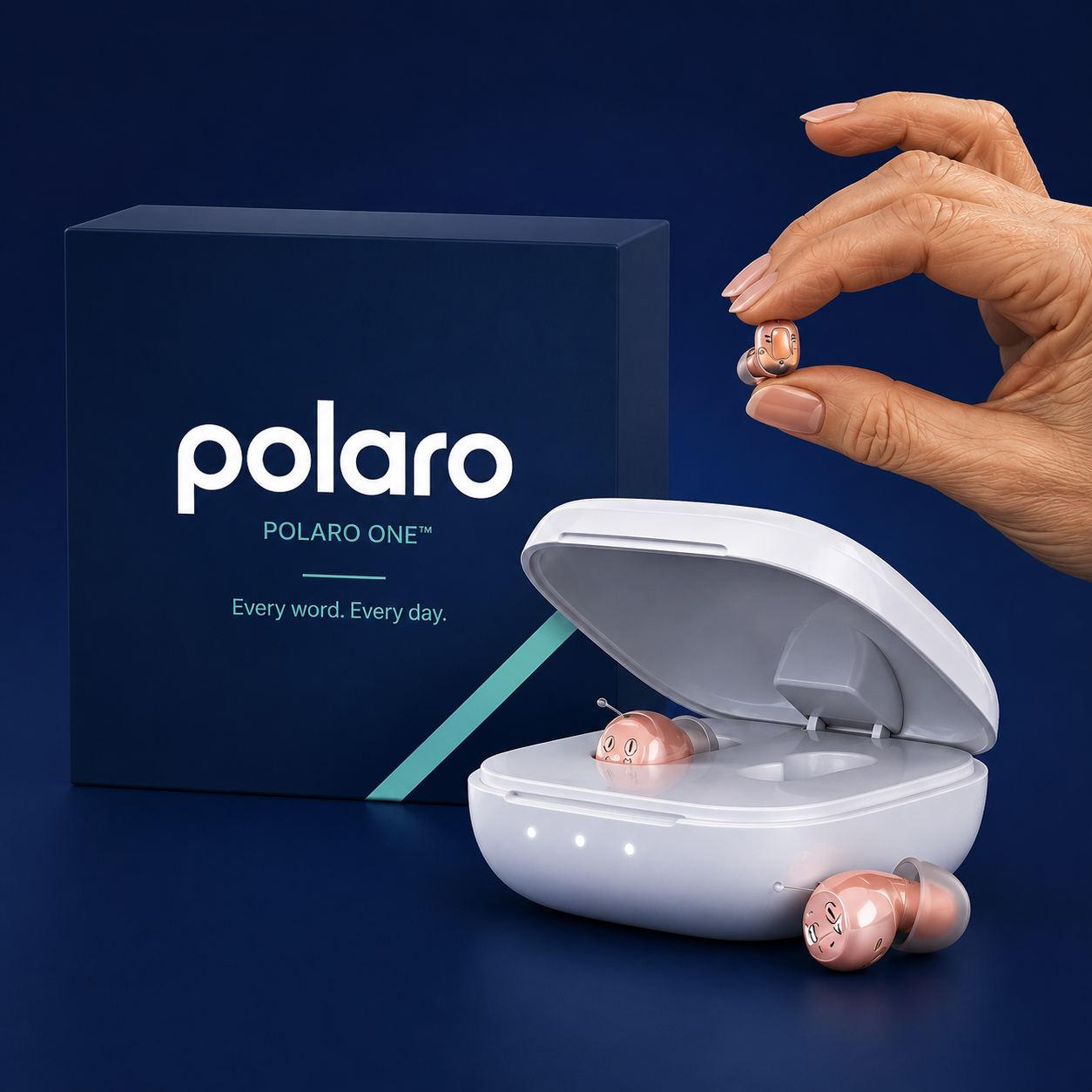
The pair, the charging case and a full set of tips. That is the whole of what turns up.
What it gets right
- 90 days at home — three times what the £3,795 device allows
- £149.99 buys the pair, not one ear
- Rechargeable throughout — no tiny cells to wrestle with, ever
- Sits down in the canal; gone at conversational distance
- 2-year guarantee — the longest of any self-fit device here
- No appointment, no audiogram, no waiting list
- Free UK delivery, out the door within 24 hours
- A full set of tip sizes in the box — fit is the entire game
Where it falls short
- No Bluetooth streaming whatsoever. If you want calls in your ears, look elsewhere
- Mild-to-moderate loss only — genuinely wrong for severe or profound
- Online only; there's no shop to hold one in first
- You fit it yourself. Most find that easy. A few won't
Why it won — in more detail than you probably need
A £149.99 pair beating kit that runs to £3,795 is exactly the sort of line that deserves checking rather than swallowing. So this bit is written to be verified, not to persuade: every figure in it is somebody's published price or published policy, and none of it leans on our opinion of the sound.
On price. £149.99 gets you the pair. The closest genuinely comparable device in the UK, the Lexie B2 (Powered by Bose), sits around £200 and runs on disposable size 312 cells at roughly £30–40 a year. By year three the Lexie has cost you more than the Polaro, plus a small mountain of spent batteries. Everything else on the list opens at £495 and needs an appointment in the diary.
On the trial. This is the part we'd ask you to lean on hardest, and the part we'd tell you to use even if you walk away and buy something else entirely.
Ninety days carries you through the adjustment, through the tip-size fiddling nobody warns you about, through the first miserable restaurant and the first good Sunday lunch, and out to the point where someone says "oh, you're back" without realising they've said it.
On the fit. A full set of tips isn't a marketing flourish. Fit is the single biggest factor in whether an in-canal device works, and it's the thing self-fitting most often gets wrong. The whistling everyone dreads — that thin feedback squeal — is almost never a fault. It's amplified sound escaping past a tip that's a size too small. A couple of minutes with the leaflet and the next size up settles it nearly every time.
Who shouldn't buy this
If an audiologist has told you your loss is severe or profound, this isn't your device and we won't pretend otherwise — go back to them. If you have ongoing discharge, sudden loss in one ear, pain or dizziness, don't buy anything off any list online; see your GP this week, because those are warning signs and none of them are fixed by a hearing aid.

“Thirty-odd years on the buses and I'd told myself my hearing was fine. My daughter had taken to repeating the waitress for me — that's what got me, when I noticed it. A month in and she's stopped. I never asked her to. She just didn't need to any more.”

“Not a soul knows I'm wearing them, which was my one rule and it's held. The whistling everybody moans about — that was me for the first few days, until I swapped the tip. Two minutes with the instructions would have spared me the bother.”
Lexie B2 (Powered by Bose)
 Shown to illustrate the type, not the exact model. The batteries are the whole story: a fresh one every few days, for as long as you own it.
What it gets right
- Bose tuning behind it. The audio engineering is not in doubt
- Among the smallest in-canal devices on sale anywhere
- App-led self-fitting that genuinely works
- A real brand with a real UK support line
Where it falls short
- Size 312 zinc-air cells. ~£30–40 a year, indefinitely
- They're a few millimetres across. You'll be changing one every few days, for good, with older hands
- 45-day returns on a device that takes six weeks to settle
- 1-year warranty
Boots Hearingcare
 The free hearing test really is free and really is worth having. What comes after it is a conversation about a range that tops out near £3,045.
What it gets right
- A trained person, in a room, who can look inside your ear
- Four years of aftercare rolled in — £300–500 of value if bought alone
- 90-day trial, level with the best on this page
- Free hearing test, no obligation. Truly free. Go and have one
- 600+ branches; there's one near you
Where it falls short
- "From £495" is the entry pair. Which? found the average Boots customer paid £2,914
- The entry model isn't the invisible one
- Appointments, in working hours, more than one
- You'll be shown the range. The range runs to £3,045
Specsavers Advance range
What it gets right
- 900+ branches — probably the easiest chain to actually reach
- Four years of aftercare included
- 90-day money-back trial
- Free test, and staff who know their stuff
Where it falls short
- The £500 entry pair still uses disposable batteries
- It's a basic digital pair. It is not invisible
- Invisible-fit and rechargeable land you well up the range
- Which? found the average Specsavers customer paid £2,143
Vibe Nano Rechargeable CIC
What it gets right
- £89 the pair. The cheapest thing here that's a real device
- Rechargeable, USB-C, invisible CIC shape
- Runs rings around any £20 marketplace amplifier
Where it falls short
- 30 days. On a device that takes six weeks to settle
- 1-year warranty against our No. 1's two
- Support gets thin if something goes wrong in month fourteen
Phonak Virto Paradise (fitted privately)
Amplifon premium range
And the route we didn't rank: the NHS
NHS hearing aids are free, they're fitted properly, the batteries are free and repairs are free. If you can wait, it is the best value in this entire article and it would be dishonest to tuck it away at the bottom without saying so out loud.
Two catches, neither of them small. First the wait — a GP referral, then an audiology appointment, then a fitting, and across much of the country that's months rather than weeks. Second, NHS provision is overwhelmingly behind-the-ear. Invisible in-canal aids are, in most trusts, simply not offered. For a lot of people that is the whole reason they're reading about invisible aids in the first place. Ask your GP for a referral today anyway. Being on the list costs you nothing while you decide what to do meanwhile — and if the meanwhile is the problem, a £149.99 pair with a 90-day trial fits neatly inside most waiting lists, every penny refundable if your NHS date comes through first.
What "invisible" really means, and how to spot when you're being sold it
Four styles get sold as invisible in the UK. Only two of them actually are.
IIC — invisible-in-canal. Sits deepest, past the second bend. Genuinely can't be seen unless someone tugs your ear forward. This is the real article. It's also the trickiest to fit and the least suited to severe loss.
CIC — completely-in-canal. Sits a touch shallower. Visible only if someone stares straight into your ear from the side, in bright light, on purpose. In a room, in conversation: invisible. Our No. 1 and the Vibe are both this style.
ITC — in-the-canal. Fills the bowl of the ear. Discreet. Not invisible. Regularly sold as invisible.
RIC — receiver-in-canal. A body behind the ear joined by a thin wire. This is what the NHS mostly fits and what the premium ranges mostly are, because the shape allows more power and a bigger battery. It is discreet. It is nowhere near invisible, and if a salesperson calls it invisible you've just learned something handy about the rest of the pitch.
 The four styles drawn to the same scale. Only the first two vanish.
Five things worth knowing before you spend a penny
1. The free hearing test is genuinely free — go and have one
Whatever you end up buying. Specsavers, Boots and Amplifon all offer one with no strings, and an audiogram is a piece of information you'll find useful for the rest of your life. It shows which frequencies you've lost and by how much, and it tells you on the spot whether you're in self-fit territory or need a clinic. Take the printout home. You are under no obligation to buy anything in the building.
2. "From £495" and "the average customer paid £2,914" are both true at once
They don't contradict each other and nobody's lying. The entry model exists. Hardly anyone leaves with it, because it runs on disposables and isn't invisible, and the moment you say either of those things out loud you're in a different tier. Decide the figure you're willing to spend before you sit down, and write it on the back of your hand if that's what it takes.
3. Two aids, not one
Hearing loss is nearly always in both ears, and your brain places sound by comparing what reaches each side. One aid gives you volume. Two give you direction — which is what actually lets you keep up with four people round a table. Every price here is for a pair, on purpose, because per-ear pricing is where a £1,900 quote quietly turns into £3,800.
4. The first week sounds wrong. That's the process, not a fault
Crisps will be deafening. Your own voice will sound like someone else's. The car indicator will make you jump. That's your auditory cortex being handed back frequencies it stopped receiving years ago, and it takes four to six weeks to relearn what's worth listening to. Which is exactly why a 30-day trial isn't a trial. Build the wearing time up gradually, at home first, and judge nothing in week one.
5. If it whistles, change the tip
Feedback whistle is almost never a broken device. It's amplified sound leaking back out past a tip that's a size too small, and going up one size fixes it the vast majority of the time. This one paragraph would have prevented a striking number of the returns we read about while putting this together.
The part of this that isn't about money
We went back and forth on whether to include this section, because it strays towards the sort of fear-selling the industry does so badly. We've kept it in because the research is real, it's recent, and it's the single most important thing on the page.
The Lancet Commission on dementia prevention has, across several reports, identified fourteen changeable risk factors that between them account for around 45% of dementia cases worldwide. The one that weighs heaviest in midlife isn't diet. It isn't blood pressure. It isn't exercise.
It's untreated hearing loss.
Said carefully, because this gets wildly overstated online
This is an association, not proof of cause. No hearing aid has been shown to prevent dementia, and any company that tells you otherwise is one to walk away from. What the researchers say, plainly and repeatedly, is to treat hearing loss, and treat it early. That's the claim. It's enough.
The way people find easiest to hold onto is simpler than the statistics. When your brain is spending most of its effort decoding speech — rebuilding the missing consonants from context, reading the face, guessing — there's very little left over to remember it. Families call that forgetfulness. An audiogram calls it something else.
The average British adult waits somewhere between seven and ten years from first noticing the problem to doing anything about it. Not because they can't afford it. Because it never quite becomes today's job. That, in the end, is what this article is really about, and it's why the £3,705 gap between the cheapest and the dearest device matters — because for a great many people, the price is the reason the decade slips by.
SEE OUR NO. 1 PICK — £149.99 THE PAIR » 90-day home trial · 2-year guarantee · free UK delivery · no appointmentFrequently asked questions
How much do invisible hearing aids cost in the UK?
Anywhere from £89 to £3,795 a pair. The high street chains publish starting prices of around £495–500 a pair, rising to roughly £3,000–3,795 at the premium end, though the invisible in-canal styles tend to sit in the upper tiers. Which? found the typical private buyer pays around £2,850 a pair. Self-fit devices bought online run from about £89 to £200 a pair, with our No. 1 pick at £149.99.
Are cheap online hearing aids any good, or are they just amplifiers?
Both are out there and the difference is what counts. A basic amplifier lifts everything at once — the conversation, the kettle, the scraping chair — which is why they end up in drawers. A proper self-fit device shapes the amplification across frequency bands, boosting the consonant range where most age-related loss lives without turning the room into bedlam. Rough rule: under about £60 a pair you're almost certainly buying an amplifier. Between £90 and £250 you're into genuine self-fit territory. Look for rechargeability, a stated frequency range, and a trial longer than 30 days.
Can I get invisible hearing aids on the NHS?
Usually not. NHS audiology overwhelmingly fits behind-the-ear or receiver-in-canal devices, because they're more powerful, easier to repair and cheaper to supply at scale. Invisible in-canal styles are rarely on offer. NHS aids are free, batteries and repairs included, and it's worth asking your GP for a referral regardless — but if being seen is your objection, the NHS route probably won't settle it.
How long should a hearing aid trial period be?
Ninety days. Below about six weeks you're still inside the neurological adjustment period, when everything sounds too bright and your own voice sounds wrong. A 30-day window runs out almost exactly as the device starts working properly, which is why so many go back. Boots and Specsavers both offer 90 days; Amplifon offers 30; among online devices, trial lengths run anywhere from 30 to 90 days. It's the single most useful number for comparing two sellers.
Do I need a hearing test before buying a self-fit hearing aid?
Not legally, for mild-to-moderate loss. But you should have one anyway, and it's free at all the major chains with no obligation to buy. It confirms your loss is in the range self-fit devices are built for, and rules out causes an aid won't fix — impacted wax, infection, or one-sided loss, which needs investigating rather than amplifying.
Will people be able to see them?
With IIC and CIC styles, in a normal conversation at a normal distance: no. Someone would have to be peering straight into your ear canal, from the side, in good light, deliberately. ITC styles that fill the bowl of the ear are visible if someone looks, and RIC styles with a body behind the ear are plainly visible from behind — discreet, not invisible, whatever the advert says.
What's the catch with a 90-day money-back trial?
With the reputable sellers, there isn't one — but read the wording first, on any offer. Three things to check: whether return postage is covered, whether there's a restocking fee, and whether the clock starts at order or at delivery. A trial with a restocking fee is a discount, not a trial.
Why is there such a big price gap for similar-looking devices?
Three reasons, largest first. One, the retail model: a high street price covers premises, staff, appointments and four years of aftercare — real costs, and real value if you use them. Two, brand and channel margin. Three, and smallest, genuine technology differences, which matter enormously for complex or severe loss and much less for the common mild-to-moderate high-frequency pattern. Whether the first two are worth £2,000 to you is the actual decision, and it turns on your hearing loss, not on the marketing.
The verdict
If your loss is severe, one-sided, sudden, painful, or comes with dizziness or discharge: none of this applies to you. Go to a GP, then to a clinic, and spend whatever it takes.
If you're one of the several million British adults with a thoroughly ordinary mild-to-moderate high-frequency loss — catching the voice, losing the words, nodding along with your own family — then the honest summary of eleven weeks' work is this:
Book the free hearing test. Take the audiogram home. Then decide with the number in front of you instead of a salesperson beside you.
And whichever way you jump, do it this month rather than next year. The average gap between noticing and acting is nearer a decade than a year, and not one person who finally sorted it has ever told us they wished they'd left it longer.
CHECK AVAILABILITY — £149.99 » Our No. 1 pick · 90 days to send them back · every penny refundedAlso tested by BestBrandsRanking
Same method, same five yardsticks fixed before testing began.
- Best knee support for arthritis — eight tested, ranked and priced
- Best back support belt — eight tested, ranked and priced
- Best shoulder support — eight tested, ranked and priced
- Best ankle support — eight tested, ranked and priced
How we're funded. BestBrandsRanking is free to read and paid for by commission on purchases made through links on this page. We take no payment for placement or for a good score, and commission does not change with ranking position. The measures used to rank all seven devices — price per pair, three-year running cost, trial length, power source and guarantee — were fixed before testing began and are drawn from each maker's or retailer's own published information, which you're free to verify yourself.
Prices. All prices were checked at the time of the last update shown at the top of this article and can change without notice. Prices marked "from" are the seller's own published starting figure and are not what most customers pay. Always confirm the current price with the seller before buying.
Medical. This article is consumer product journalism, not medical advice. Hearing aids do not treat, cure or prevent any disease, dementia included. Self-fit devices are for perceived mild-to-moderate hearing loss in adults aged 18 and over. Sudden hearing loss, one-sided loss, pain, discharge, newly-started tinnitus or dizziness need assessment by a doctor and are not suitable for self-treatment. If in doubt, see your GP.
- Which? — Hearing aid prices: how much do hearing aids cost? Independent pricing research across Amplifon, Bayfields, Boots Hearingcare, Hidden Hearing, Leightons, M&S, Scrivens and Specsavers.
- Boots Hearingcare — published UK hearing aid price ranges.
- Specsavers — published Advance range pricing and 90-day trial terms.
- Amplifon — published range pricing and trial terms.
- Livingston G. et al. — Dementia prevention, intervention, and care, Lancet Commission reports (risk-factor analysis; association only).
- US FDA — 21 CFR 800.30, over-the-counter hearing aid category, effective October 2022.